About the LWA
Sponsors
Construction of the LWA has been supported by the Office of Naval Research under Contract N00014-07-C-0147 and by the AFOSR. Support for operations and continuing development of the LWA stations is provided by the Air Force Research Laboratory, the Naval Research Laboratory, and the National Science Foundation under grants AST/1835400, and CISE/2103707.



Background
Here is a drone footage movie of the LWA-SV station produced by Paul Harden. Hopefully this will give you a feel for what an LWA station looks like. If you want to know how we build LWA antennas then check out this movie from Niky Taylor showing all the steps.The LWA will be a low-frequency radio telescope designed to produce high-sensitivity, high-resolution images in the frequency range of 10-88 MHz, thus opening a new astronomical window on one of the most poorly explored
regions of the electromagnetic spectrum. This will be accomplished with large collecting area (approaching 1 square kilometer at its lowest frequencies) spread over an interferometric array with baselines up to at least 400 km, located mainly in the state of New Mexico. 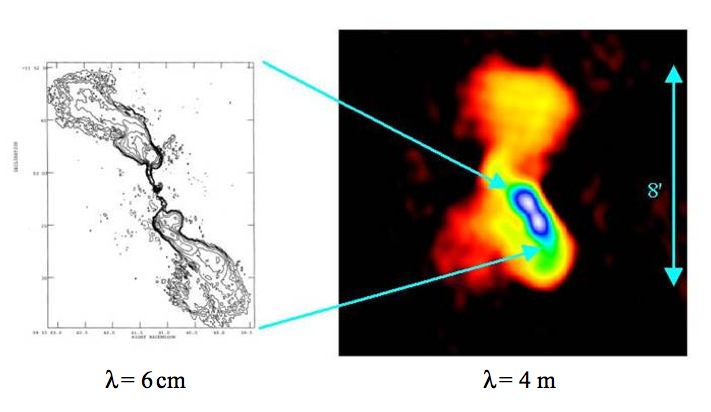
The images shown to the left are of the galaxy Hydra A, mapped at 6 cm and 4 m (74 MHz) with the VLA. Only at long wavelengths is the full extent of the source revealed. Such images have fueled the activity behind the planning and creation of this array.
The LWA is sited primarily in New Mexico, with the core near the site of the Very Large Array. As of 2026 the LWA consists of two full stations and one mini-station:
- LWA1 — 256 dipoles, co-located with the VLA
- LWA-SV — 256 dipoles, at the Sevilleta National Wildlife Refuge
- LWA-NA — 64-element mini-station at the North Arm of the VLA
Two additional mini-stations are currently under construction at Texas Tech University and Arizona State University.
Key Science Drivers
- Acceleration of Relativistic Particles in:
- Hundreds of supernova remnants in normal galaxies at energies up to 1015 eV
- Thousands of radio galaxies & clusters at energies up to 1019 eV
- Ultra-high energetic cosmic rays at energies up to 1021 eV and beyond
- Cosmic Evolution & the High Redshift Universe
- Evolution of Dark Matter & Energy by differentiating relaxed and merging clusters
- Study of the 1st black holes & the search for HI during Epoch of Reionization (EOR) & beyond
- Plasma Astrophysics & Space Science
- Ionospheric Waves & Turbulence
- Acceleration, Turbulence, & Propagation in the interstellar medium (ISM) of Milky Way & normal galaxies
- Solar, Planetary, & Space Weather Science
- Transient Universe
- Possible new classes of sources (coherent transients like GCRT J1745-3009)
- Magnetar Giant Flares
- Prompt emission from gamma ray bursts (GRBs)
- Radio afterglows from meteors and fireballs
- Extra-Solar Planets
- Detection of exoplanets via coherent radio emission analogous to Jupiter's decametric bursts
- Measurement of exoplanetary magnetic field strengths, rotation periods, and presence of exo-moons
- Pulsars & the Interstellar Medium
- Resolving pulsar scattering disks to characterize the ISM and measure pulsar distances
- Informing noise models for pulsar timing arrays used in gravitational wave detection
Partner institutions
The LWA Project includes several institutions. The founding LWA members are the University of New Mexico, the Los Alamos National Laboratory in partnership with the Naval Research Laboratory. Virginia Tech and University of Iowa joined the LWA Project in July 2007 and the Jet Propulsion Laboratory joined in September 2008.
List of Participating Institutions:
- University of New Mexico
- Texas Tech University
- Arizona State University
- Naval Research Laboratory
- University of Iowa
- Virginia Tech
- Los Alamos National Lab
- Jet Propulsion Laboratory
The Square Kilometer Array (SKA) and the LWA
The SKA project officially recognizes the LWA as an SKA Pathfinder.
More about the LWA
To download some brief information click here for a popular information sheet or here for a more technical brochure. See also LWA Memo 210: The Swarm Development Concept for the LWA.