The LWA Swarm
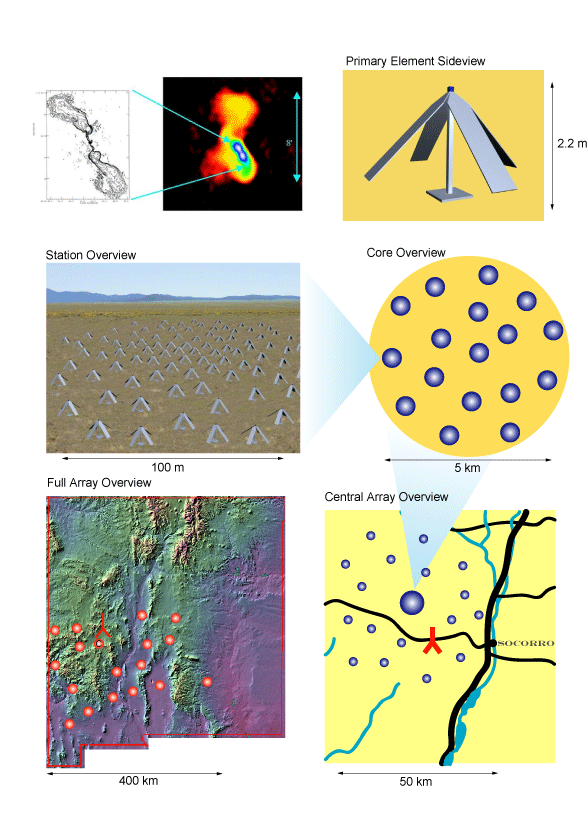
The LWA Swarm is a development concept for the Long Wavelength Array that creates a powerful continental-scale telescope by distributing LWA stations and mini-stations to universities and colleges across the US. Each station operates independently for local scientific interests while also participating jointly as part of the LWA Swarm through a very long baseline interferometry (VLBI) mode. This model energizes a multi-disciplinary community and provides students with hands-on opportunities to learn about instrumentation and science.
With stations distributed across the US, the LWA Swarm will achieve an angular resolution of ~0.5 arcseconds and ~5 mJy-level sensitivity in a 4-hour observation at 74 MHz—capabilities superior to any other instrument currently operating in this frequency range.
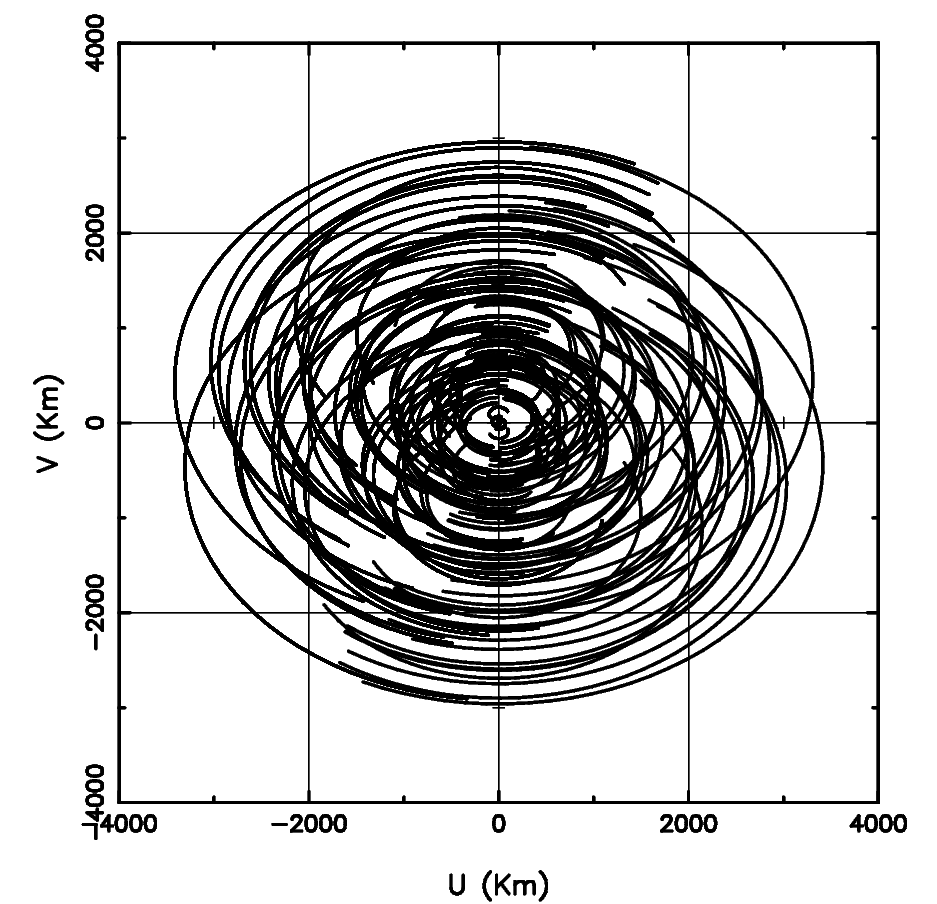
Simulated (u,v) coverage for the LWA Swarm observing a source at declination 47° using the 3 existing LWA stations in NM and CA plus 10 additional stations distributed around the US.
Key Science Goals
Extra-Solar Planets — All planets in our solar system with magnetic fields produce coherent low-frequency radio emission, with Jupiter outshining all other sources below 40 MHz. The LWA Swarm's high-resolution imaging will overcome the confusion noise that has limited previous searches, enabling detection of Jupiter-like exoplanets out to ~5 pc at 30 MHz. Detecting such emission would allow measurement of exoplanet magnetic field strengths—critical to atmospheric retention and the development of life—as well as rotation periods and the presence of exo-moons.
Pulsar Scattering — The LWA Swarm will achieve sub-arcsecond resolution, enabling it to resolve the scattering disk for numerous pulsars. Since scattering disk size scales as the square of the wavelength, observations in the LWA frequency range can probe scattering structure using significantly shorter baselines than higher-frequency facilities. This will reveal characteristics of the interstellar medium and provide new distance measurements to pulsars, while also informing noise modeling for pulsar timing arrays used in gravitational wave detection.
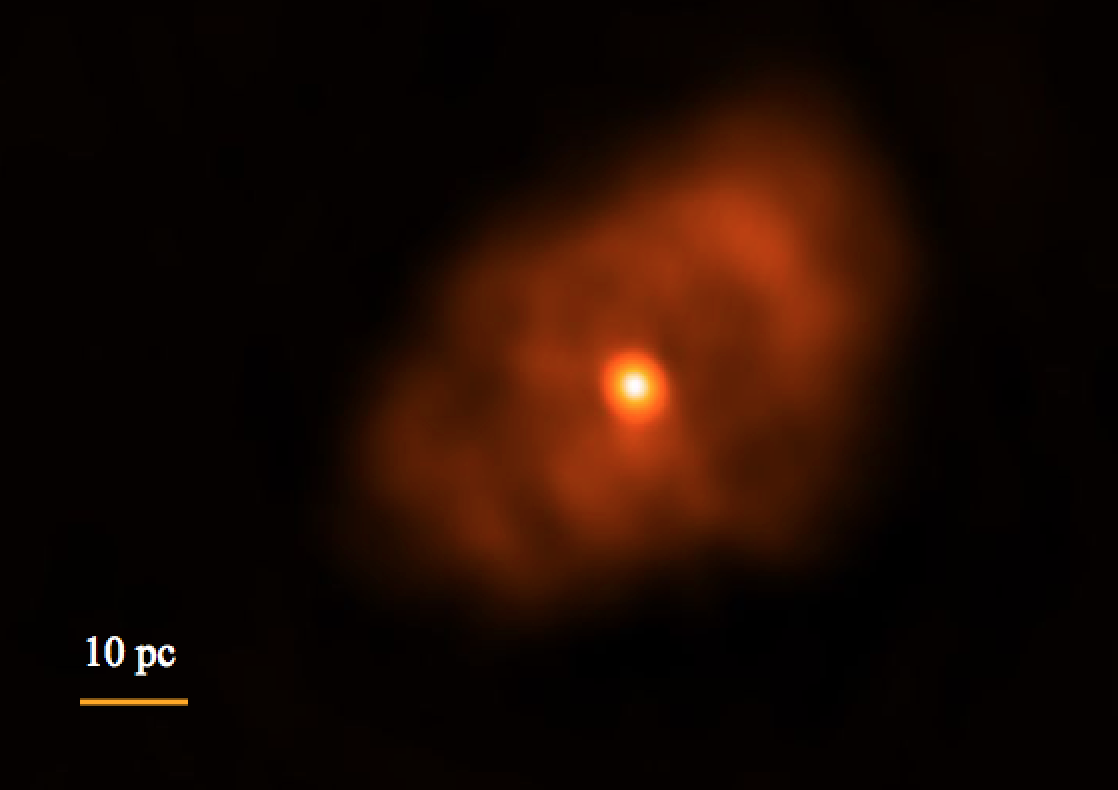
ELWA observation of the Crab pulsar obtained with two LWA stations and 23 VLA antennas at 74 MHz with 8 MHz bandwidth and 4 hours on source. Peak flux density is 38 Jy with an rms noise of ~40 mJy/beam.
See also the Science Drivers page for more details on LWA science objectives.
Station Design
The LWA Swarm encompasses both full stations (256 dipoles) and mini-stations (48–128 dipoles). Mini-stations use a core layout matching the full station design plus a Gaussian-tapered distribution of outer dipoles, making it straightforward to expand a mini-station to a full station as funding becomes available. Simulations show that 48 dipoles is the minimum useful number for producing reasonable sky images and achieving adequate baseline sensitivity.
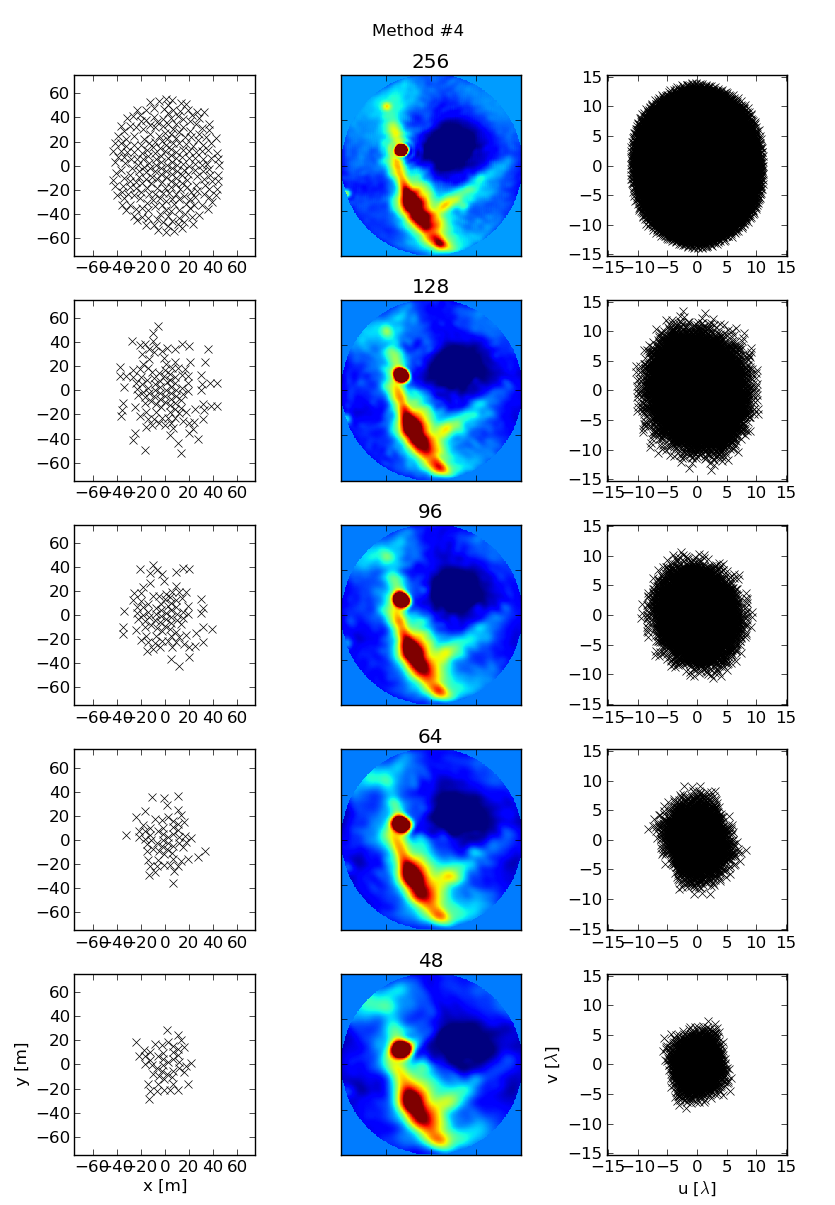
Mini-station configurations ranging from 256 dipoles (top) to 48 dipoles (bottom). Left column: physical station layout. Center column: imaging fidelity and resolution at 38 MHz. Right column: (u,v) coverage at 38 MHz.
Participating Institutions
| Institution | Contact | Dipoles | Status |
|---|---|---|---|
| UNM | G. Taylor | 256 × 2; 64 × 1 | Operational |
| Caltech | G. Hallinan | 352 | Operational |
| Quest University | I. M. Hoffman | 48 | |
| University of Kansas | D. Besson | 48 | |
| Embry-Riddle Aeronautical University | A. Gretarsson | 48 | |
| Texas Tech University | T. Maccarone | 48 × 2 | |
| Arizona State University | J. Bowman | 256 | |
| UT Rio Grande Valley | F. Jenet | 48 | |
| University of Florida | A. Gonzalez | 48 | |
| UC Boulder | J. Burns | 256 | |
| SUNY Old Westbury | M. Kavic | 48 | |
| Hillsdale College | T. Dolch | 48 |
For more details, see LWA Memo #210: The Swarm Development Concept for the LWA (Taylor et al.).
Original Design Concept
The original LWA design concept documents describe the initial station architecture. Click the image below for the detailed design concept (PDF). A newer version of the station architecture superseding this document can be downloaded here.