|

Welcome
About the LWA & the SWC
Key Science Drivers
A Summary
Science Drivers
Details
The LWA Design Concept
LWA - Basic Specs
Career Opportunities
Current Progress
Progress thru Photos
(LWDA & LWA)
The LWA Wiki pages
presentations, etc.
Education & Public Outreach
Project Documents
Consortium Documents
LWA Testing
Publications< Contact Information and Campus Maps
Links
|
Progress through Photos
This webpage is devoted to Progress through Photos; as the
construction of the LWDA test station at the VLA develops and sites for other
LWA stations are explored, we will replace older photos with newer ones.
Additional photos may be found on the
LWA Wiki
LWA Executive Project Director hired.
Dr. Lee J. Rickard was hired at UNM in April 2007
in the position of Executive Project Director for the Long Wavelength
Array (LWA). Lee J. was formerly at the Naval Research Lab,
and is a well respected scientist who has published in both ionospheric
and astronomical journals. Lee J. will be establishing
the LWA Project Office on South Campus at UNM.
|
|
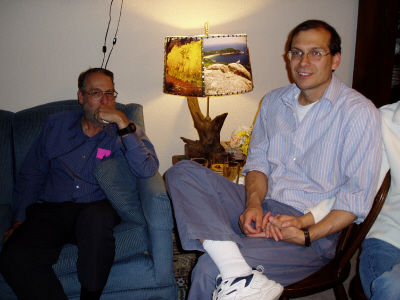
The two LWA Directors - Left: Lee J. Rickard, Executive Project Director and Right: Greg Taylor, Scientific Director - at a party celebrating Lee J.'s arrival.
|
| |
return to top
Site Testing for LWA Stations
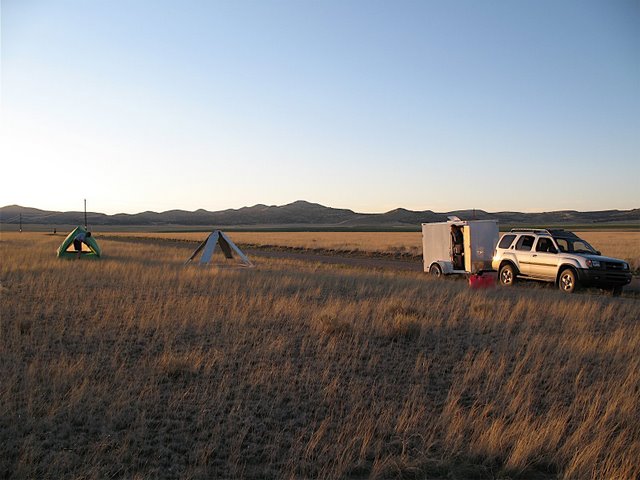
The first overnight RFI testing at potential LWA stations took place
at the VLA North Arm and Magdelena sites during June 25-27, 2007.
|
|
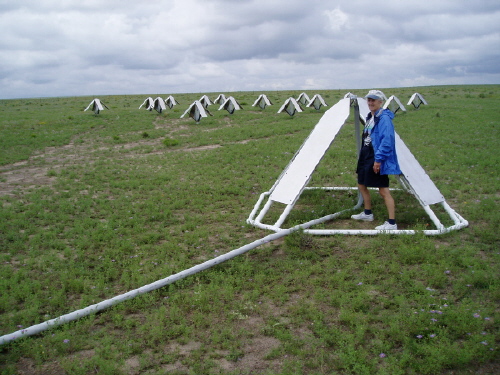
"Campsite" just off the North Arm of the VLA includes a tent, one of the Big Blade antennas plus the new trailer - June 25, 2007.
|
| |
|
|
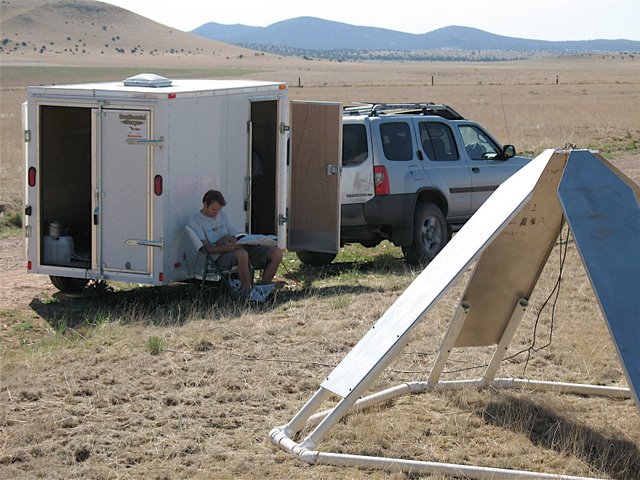
As a member of the team to select sites for the LWA stations, UNM graduate student Frank Schinzel is reviewing maps while data on Radio Frequency Interference are being recorded by computer inside the trailer at a location in the northern part of the Plains of St.Augustine in Socorro County. The signals are picked up by the blade antenna in the front right of the picture.
|
| |
return to top
Testing for radio interference at potential sites for other LWA stations began in December 2006.
|
|
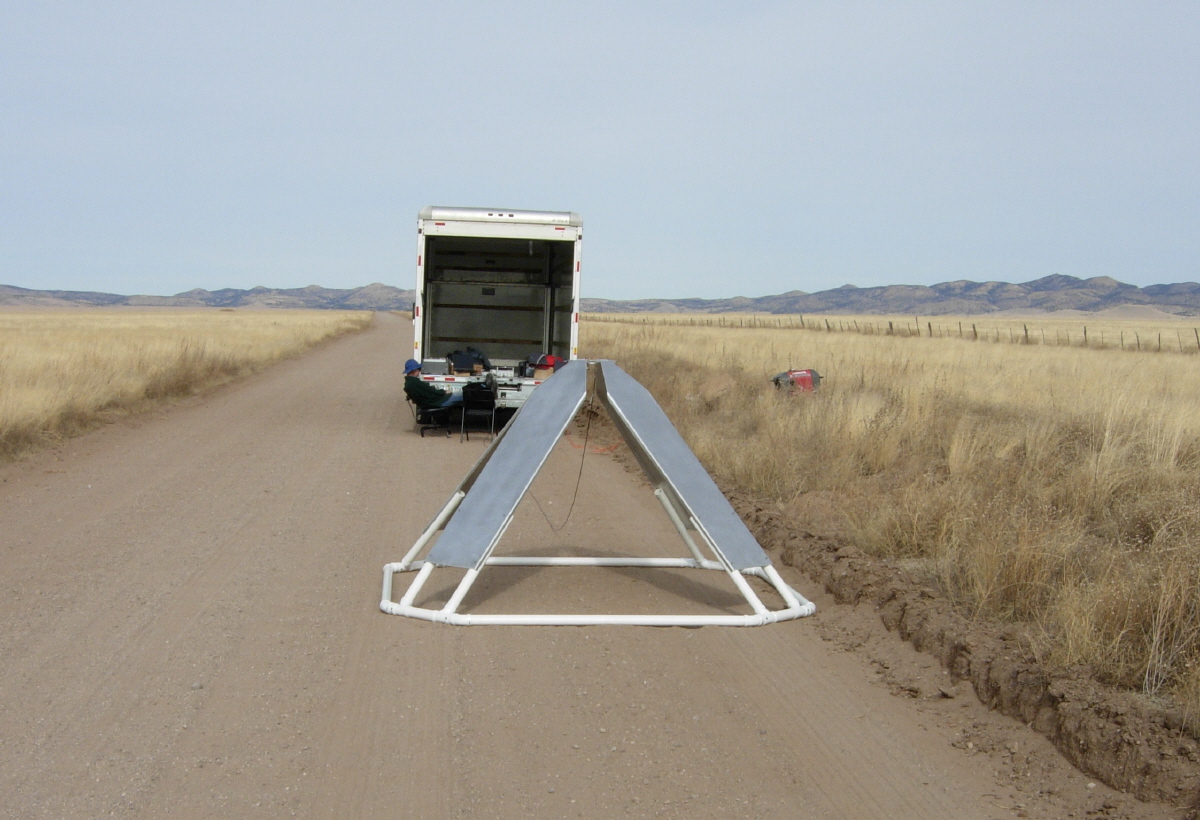
Testing at the Twin Peaks site - located north of US 60 and west of the North arm of the VLA. U-Haul truck with test equipment, big blade antenna infront and power supply equal red item in field to the right. December 15, 2006
|
| |
return to top
Welcome to the Construction site
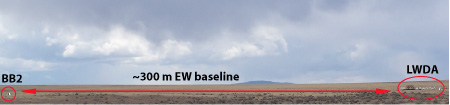
The LWDA is a test bed for the development of the LWA - it is located on the VLA site.
During the week of May 14, 2007 an LWA team working with Bill Erickson set up an
outlier antenna to work with the LWDA as an interferometer. The outlier is
the second of the Big Blade antennas currently at the LWDA site (aka BB2)
and is located approximately 300 meters due East of the 16 element LWDA. The
interferometer allows us to achieve high Signal-to-Noise measurements on
many known discrete radio sources. In turn, that allows us to constrain
technical characteristics of the LWDA more accurately than previously
possible, including accurate flux and phase calibration. The interferometer
also brings a new operational mode for targeted source observations, in
addition to the current all-sky monitoring and phased array beam-forming
modes of the LWDA alone. The LWDA and outlier are remotely configurable
between various modes, including with multiple beams, and a number of
innovative science programs are being considered to take advantage of these
capabilities.
|
|
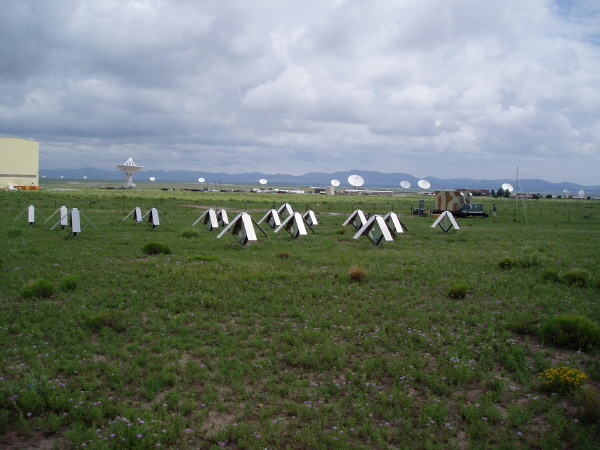
Landscape photo showing the approximate 300 m separation between Big Blade 2
(BB2 - on the left) and the 16 element LWDA (on the right).
|
|
|
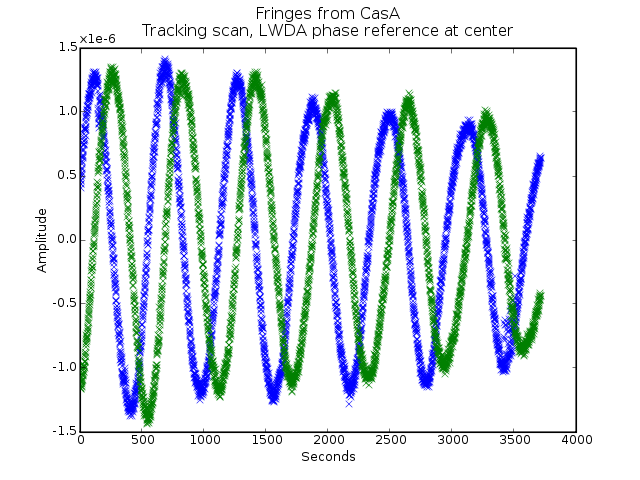
SINE and COSINE interferometer fringes on the bright radio source Cas A at
74 MHz. The operational mode employed was a tracking two element
interferometer between the outlier Big Blade antenna (BB2) and the phased
array LWDA. Each point represents 1 second of data at 1.6 MHz instantaneous
bandwidth.
|
return to top
The Specmaster Data website lets you view Daily Dynamic Spectra and learn about special events from Big Blade at the LWDA site.
|
|
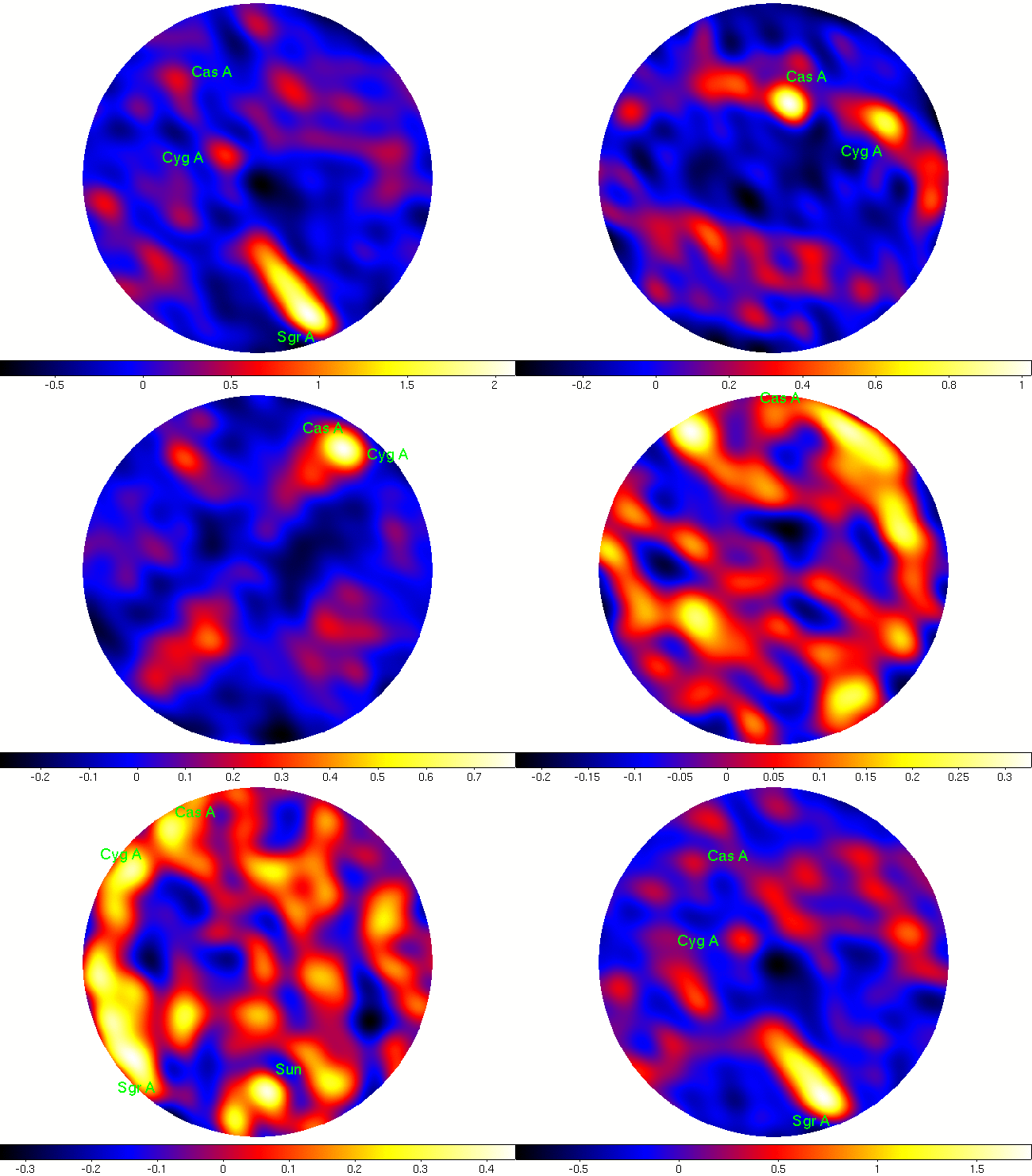
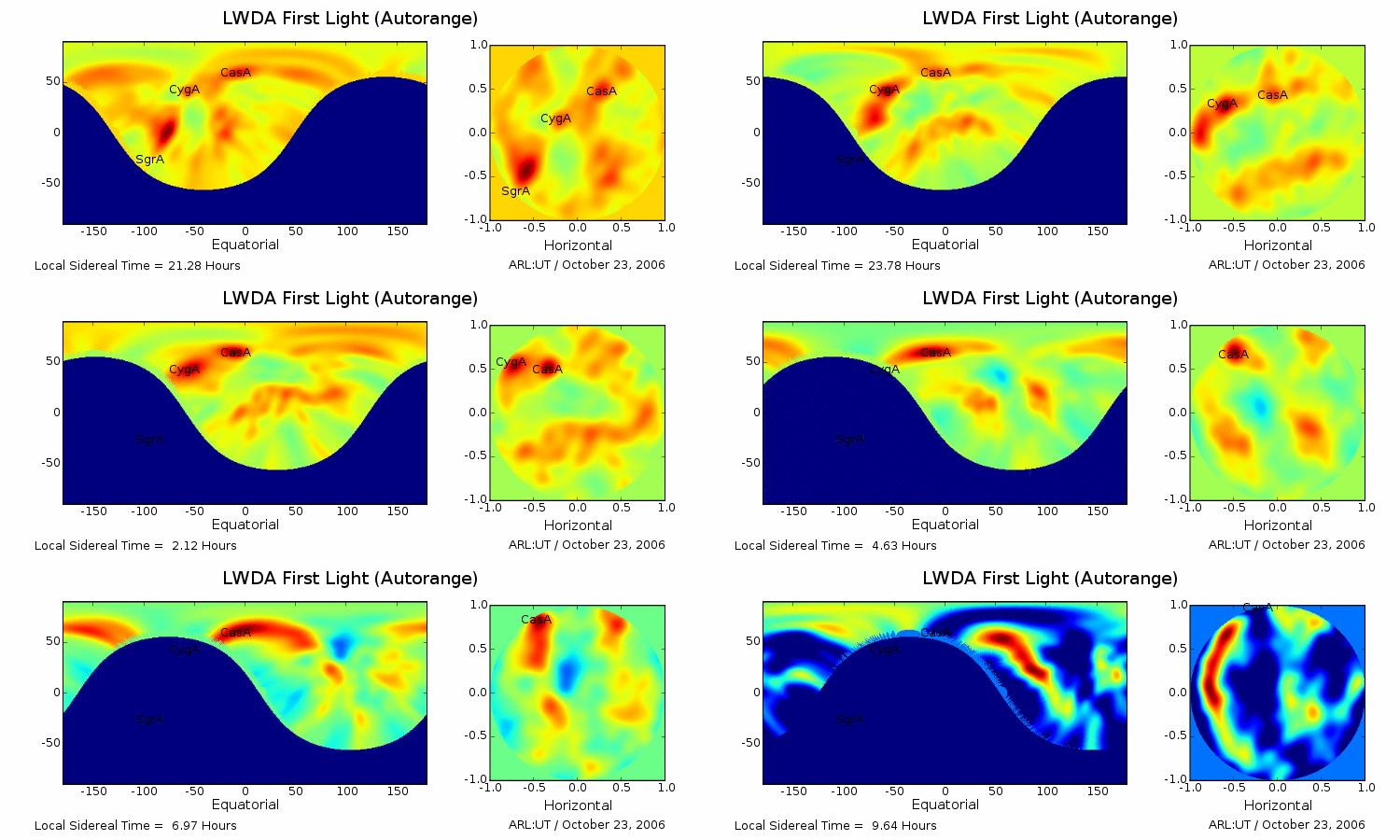
Commissioning observations made in October 2006 by the Long Wavelength Demonstrator Array (LWDA) highlight its all sky imaging capability. This 24 hour movie (also available in mpg format) is made at a frequency of 73.8 MHz and shows the full sky as visible from the LWDA site in New Mexico. As the sky rotates, emission from the bright sources Cassiopeia A, Cygnus A, and the Sun, as well as the bright regions of the Galactic Plane, are all clearly visible. The Galactic Center region is marked by the position of the Sagittarius A complex. This movie was made by Tracy Clarke (NRL/Interferometrics Inc) using AIPS to process the observations from the LWDA.
|
|
|
During second half of October 2006 all the hardware was installed at the site, including both polarizations and digital receivers for all the dipoles. Careful phase calibrations were performed and these movies demonstrate how successful they were. Congratulations to all who made this possible.
|
return to top
|
|
|
LWDA site - 16 dipoles and electronics trailer (right back) with VLA
antennas in the background as photographed in early August 2006.
|
|
|
| New large blade antenna for testing (photo - August 2006).
|
|
|
| The first results are displayed
in power point presentations at URSI and AAS in January 2006.
|
|
|
| Construction of the LWDA began at the VLA site
during the Autumn 2005.
|
| |
return to top
|
|
LWA-UNM
LANL
LWA-NRL
ARL-UT
VT
UI

|
|
LWA Contact Information:
Greg Taylor - gbtaylor@unm.edu - 505-277-5238
Patricia Henning - henning@astro.phys.unm.edu
- 505-277-3166
Frank Gilfeather - gilfeath@unm.edu
- 505-272-7042 or 505-269-0346 (cell)
University of New Mexico • Albuquerque, NM 87131
Web Administrator (Hélène Dickel) Email: h-dickel@phys.unm.edu
|
|