


 |
 |
The dramatic successes with the narrow-band VLA system ([Kassim et al. 1993])
of modest collecting area ( m
m ) and unprecedented
angular resolution (
) and unprecedented
angular resolution (
 ) provide strong incentives to
develop a much larger (
) provide strong incentives to
develop a much larger ( 500 km baselines) and more sensitive
(
500 km baselines) and more sensitive
(
 m) instrument. A completely
electronic Long Wavelength Array (LWA) could explore the entire LW
spectrum at unmatched levels of sensitivity (sub-mJy) and angular
resolution (arc-second) ([Kassim & Erickson 1998]). Moreover, the ability to do
this from the ground with intrinsically modest bandwidths and
relatively inexpensive hardware permits the array to be developed at a
fraction of the cost of higher frequency ground- or space-based
systems of comparable size and sophistication. The approximately
$25,000
total cost of the hardware required for the development of the 74 MHz
NRL-NRAO system is dramatic testimony to this fact.
m) instrument. A completely
electronic Long Wavelength Array (LWA) could explore the entire LW
spectrum at unmatched levels of sensitivity (sub-mJy) and angular
resolution (arc-second) ([Kassim & Erickson 1998]). Moreover, the ability to do
this from the ground with intrinsically modest bandwidths and
relatively inexpensive hardware permits the array to be developed at a
fraction of the cost of higher frequency ground- or space-based
systems of comparable size and sophistication. The approximately
$25,000
total cost of the hardware required for the development of the 74 MHz
NRL-NRAO system is dramatic testimony to this fact.
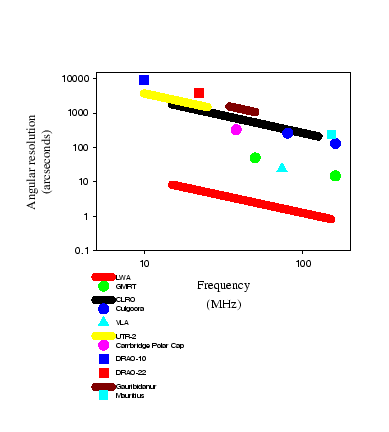
Figures 4 and 5 illustrate the landmark improvements the LWA, with its 400-km baselines, could achieve in the LW range over past or present instruments. Figure 4 shows that the LWA will surpass, in most cases by two orders of magnitude or more, the angular resolution of available low-frequency instruments. While a few instruments are edging towards improved angular resolution at one or two ``spot'' frequencies (e.g., the GMRT at 50 and 160 MHz, the VLA at 74 MHz), Figure 4 shows that the LWA can provide high angular resolution with a broad frequency coverage.
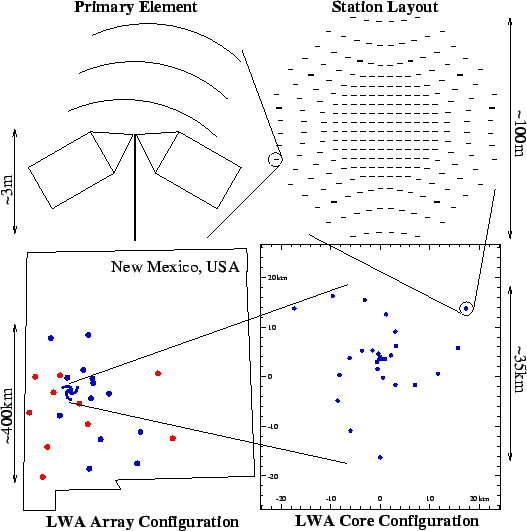 |
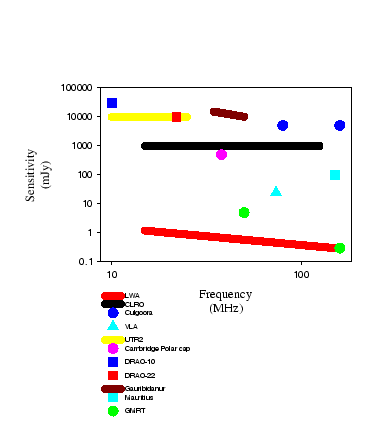
Figure 5 shows that the LWA achieves a parallel
breakthrough in sensitivity, even over instruments with comparable
collecting areas (e.g., UTR2 with
m),
reflecting the impact of improved angular resolution on limiting
source confusion, a key limit to the sensitivity of low frequency
instruments. The importance of reducing source confusion is
demonstrated by the the impressive relative sensitivity of the 74 MHz
VLA system which has a collecting area of only
 m.
m.
Fortunately, collecting area is inexpensive at long wavelengths. This is because simple wire antennas can be mass produced and because system temperatures are dominated by the Galactic background, making low-cost preamplifiers entirely adequate. The modest intrinsic bandwidths also result in very low receiver and associated electronic costs.
Figure 6 shows a possible LWA layout with maximum baselines of order 400 km whose basic building block is a simple, linearly polarized crossed-dipole.
 dependent collecting area assumed to be
  m
m