


Even though radio astronomy was founded by Jansky at decametric
wavelengths, the urgent quest for ever higher angular resolution and
the fact that ionospheric structure limits interferometric imaging to
short ( 5 km) baselines at long wavelengths (LW, taken to be
2-20 m or 15-150 MHz), has left the LW region among the most poorly
explored in the entire spectrum. This is despite the many important
astrophysical questions which can be addressed only by LW
observations, in addition to those problems which may be usefully
addressed at a variety of wavelengths, but which may be done so with
unparalleled efficiency in the LW regime. Thus the recent
demonstration by the 74 MHz VLA system ([Kassim et al. 1993]), that
self-calibration can accurately remove ionospheric distortions over
arbitrarily long baselines, now offers the exciting opportunity to
efficiently and economically open a new high-resolution,
high-sensitivity window on the electromagnetic spectrum at the longest
wavelengths ([Kassim & Erickson 1998]).
5 km) baselines at long wavelengths (LW, taken to be
2-20 m or 15-150 MHz), has left the LW region among the most poorly
explored in the entire spectrum. This is despite the many important
astrophysical questions which can be addressed only by LW
observations, in addition to those problems which may be usefully
addressed at a variety of wavelengths, but which may be done so with
unparalleled efficiency in the LW regime. Thus the recent
demonstration by the 74 MHz VLA system ([Kassim et al. 1993]), that
self-calibration can accurately remove ionospheric distortions over
arbitrarily long baselines, now offers the exciting opportunity to
efficiently and economically open a new high-resolution,
high-sensitivity window on the electromagnetic spectrum at the longest
wavelengths ([Kassim & Erickson 1998]).
 |
 |
 |
The jointly developed NRL-NRAO 74 MHz observing system came fully on
line in 1998 January with all 27 antennas equipped with 74 MHz
receivers (prior to this a prototype system was installed on 8
antennas). The system has already attracted a wide variety of
innovative observing proposals with encouraging initial results in
solar system (planetary emission, solar bursts), Galactic (pulsars,
supernova remnants), and extragalactic (cluster halos, radio galaxies)
astrophysics. Figures 1-3 provide dramatic
examples of the types of images currently being produced by this
system. Figure 1 is an image of the Galactic supernova
remnant (SNR) Cas A and provides only the second direct case (after
SN 1006, [Hamilton & Fesen 1988]) of evidence for unshocked ejecta interior to the
reverse shock in a young SNR ([Kassim et al. 1995b]), as predicted by various
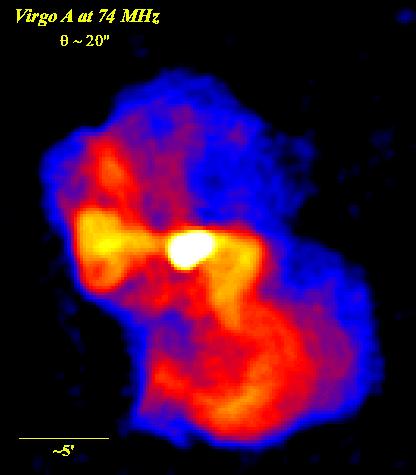
theoretical analyses (e.g., [Lozinskya 1992]). Figure 2 is an
image of the radio galaxy Virgo A and provides important evidence that
the large-scale radio halo is a response to the activity of the black
hole-jet system and, contrary to conventional wisdom, is a relatively
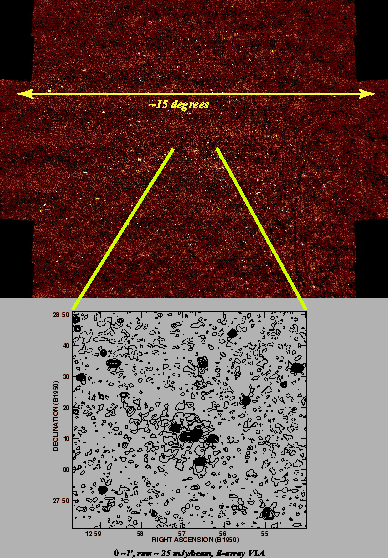
young feature ([Owen et al. 1999]). Figure 3 is a deep (rms
noise level  25 mJy beam
 ) image of the field
containing the Coma cluster of galaxies (P. P. Kronberg 1999, private
communication). The detection of the emission from the steep spectrum
halo is important to theories of particle acceleration and magnetic
fields in clusters of galaxies. Moreover, the amazing field of view
(
) image of the field
containing the Coma cluster of galaxies (P. P. Kronberg 1999, private
communication). The detection of the emission from the steep spectrum
halo is important to theories of particle acceleration and magnetic
fields in clusters of galaxies. Moreover, the amazing field of view
(
 ), angular resolution (
 ), and sensitivity
( 25 mJy beam) provided by this single VLA pointing
testify to the dramatic imaging power offered by low frequency
systems.
), and sensitivity
( 25 mJy beam) provided by this single VLA pointing
testify to the dramatic imaging power offered by low frequency
systems.
Now that the ionospheric barrier has been removed, such images can reveal unique information not only for important large-scale emission studies (e.g., SNRs, the Galactic center, galaxy and cluster halos), but also for studies which benefit from high sensitivity to small-diameter steep spectrum sources (e.g., pulsars and high redshift radio galaxies) which can now be obtained with incredible efficiency. Furthermore, a sensitive, high angular resolution, low frequency instrument would also be the ideal receiver for solar radar, an innovative concept which could image Earthward-bound coronal mass ejections (CMEs), thereby opening up a new field of space weather research and prediction.
 , and the field covers approximately 15
 at a
resolution of 1
at a
resolution of 1 .
(Bottom) A subimage of the wide-field image showing the
central galaxies and the cluster halo.
.
(Bottom) A subimage of the wide-field image showing the
central galaxies and the cluster halo.