Bill Erickson and the path to the LWA
A good general reference for those interested in learning more about the LWA project is
From Clark Lake to the Long Wavelength Array: Bill Erickson's Radio
Science (ASP Conference Series, V345, Proceedings of the Conference held
8-11 September, 2004 in Santa Fe, New Mexico, USA. Edited by N. Kassim, M. Perez,
M. Junor, and P. Henning). These Proceedings contain a variety of papers which review
scientific and technical aspects of the project during its early stage, including
one on The Legacy of Clark Lake from which
some of the photos shown here were taken.
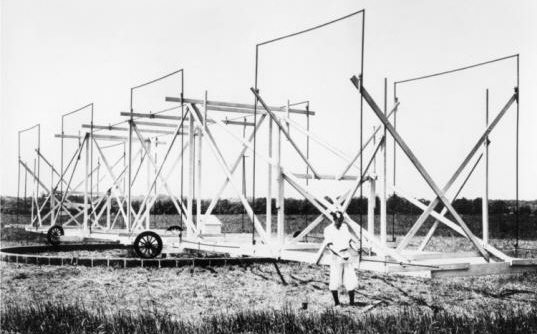
The Jansky telescope
Bill Erickson was born about a year before Karl Jansky discovered
cosmic radio waves in 1931 and ushered in the birth of radio astronomy.
Jansky's antenna, pictured here, was designed to receive radio waves
at a frequency of 20.5 MHz, near the lower end of the LWA frequency range.
ASP Conference Series V345 also includes a copy of one of Jansky's now
famous early publications, together with reproductions of several other
historical papers from the birth of radio astronomy at low frequencies.
The History of the Clark Lake Observatory
In the late 1950s, Convair Scientific Research Lab created CSRL in San Diego.
Bill Erickson, former student of Director Critchfield, was hired to begin work at Clark Lake
in the Anza Borrego desert in southern California.
By the early 1960s, Convair transferred what became the Clark Lake Radio Observatory
(CLRO) to the University of Maryland under Professor Bill Erickson. (See Erickson's
article in the
ASP Conferences Series V345 for further background).
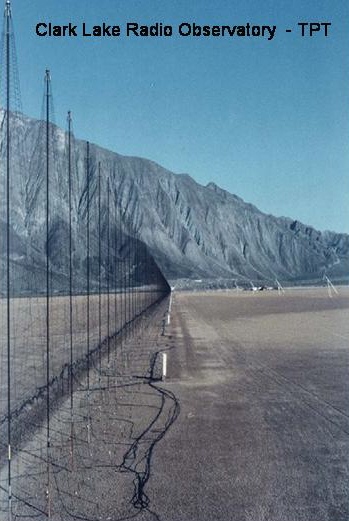
The Clark Lake Teepee-Tee Telescope was the last in a succession of
innovative instruments developed in the 1970s by Bill Erickson and his students
(Polisensky & Kassim 2005).
The ~3 km TPT was a a broad-band (10-123 MHz), fully electronic, fast and versatile
instrument that will only be surpassed in capability and sophistication by the
emerging much larger (>100 km) instruments such as the LWA.
The 74 MHz system on the Very Large Array
One of the first proposals to extend earlier techniques to frequencies below 100 MHz
with a connected element, synthesis imaging array was made shortly
after self-calibration was first introduced, when Rick Perley and Bill Erickson
proposed development of a large, dipole-based array to work alongside the VLA in New Mexico.
(G. Swarup's original concept for the
GMRT also appeared at about this time.)
Funding to implement the sensitive, broad-band, ambitious system originally
envisaged in VLA Technical Memorandum #146 (Perley and Erickson 1984 - reproduced
as LWA Memo #1.pdf)
was not readily available at that time. However, their proposal inspired the Naval
Research Laboratory (NRL) and National Radio Astronomy Observatory (NRAO)
to work together in the early 1990s to implement a narrow-band, modest version
of the Perley-Erickson proposal using the existing VLA dishes and infrastructure.
The 74 MHz System on the Very Large Array
with 74 MHz receivers on all 27 VLA antennas, became operational
in 1998. It attracted a wide variety of scientific projects in the areas of solar
system (planetary emission, solar bursts), Galactic (supernova remnants, ISM),
and extragalactic (clusters, radio galaxies) astrophysics. A major project
is the VLA Low Frequency Sky survey
(VLSS) a 74 MHz
complement to the successful NVSS 20 cm VLA sky survey.
See
The NRL-NRAO 74 MHz VLA for further details.
The Bruny Island Radio Spectrometer (BIRS)
Bruny Island lies off the south-eastern corner of Tasmania, Australia.
Since 1 January 1998 low frequency solar radio burst observations have been
made daily with the Bruny Island Radio Spectrometer
(BIRS) developed by Bill Erickson.
Since 15 September 2006, the solar burst data appear on the Green Bank Solar Radio
Burst Spectrometer website .
Earlier data were on a University of Tasmania web site and can be made available by contacting
Bill Erickson.
 The frequency range of the observations is from the low frequency ionospheric cutoff
to 62.5 MHz. The ionospheric cutoff occurs at a frequency at which radio waves from
the Sun suffer total reflection by the Earth's ionosphere and is normally between
7 MHz and 12 MHz: it is a strong function of the local elevation of the Sun.
Only the 12 to 62 MHZ frequency range is normally displayed on the website.
The frequency range of the observations is from the low frequency ionospheric cutoff
to 62.5 MHz. The ionospheric cutoff occurs at a frequency at which radio waves from
the Sun suffer total reflection by the Earth's ionosphere and is normally between
7 MHz and 12 MHz: it is a strong function of the local elevation of the Sun.
Only the 12 to 62 MHZ frequency range is normally displayed on the website.
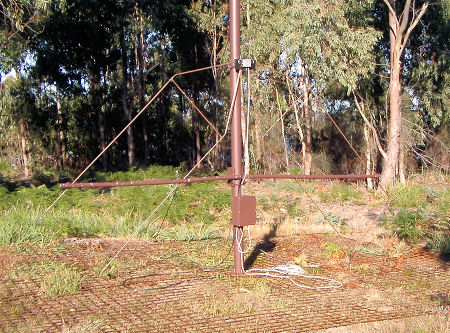
The solar emissions are received with the wide-band, droopy, active dipole shown in the
accompanying photo above. This antenna may be considered one of the first bona fide LWA
prototype antennas!
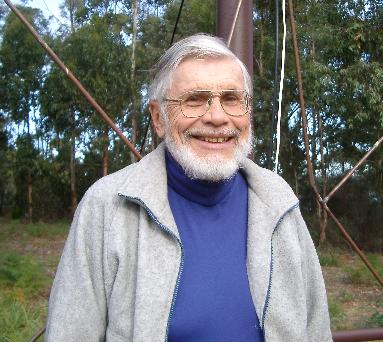
The Grote Reber Medal
In 2005, the Inaugural
Grote Reber Medal was awarded to Bill Erickson,
Professor Emeritus at University of Maryland and Honorary Research Associate at the
University of Tasmania. Professor Erickson was recognized for his innovative
contributions to radio astronomy, especially for his many novel techniques
which have been the forerunner of the new generation of metre-wavelength radio telescopes.
Currently he operates his own private radio observatory on Bruny Island in Tasmania.
(Photo from the cited website article.)
The Long Wavelength Array (LWA)
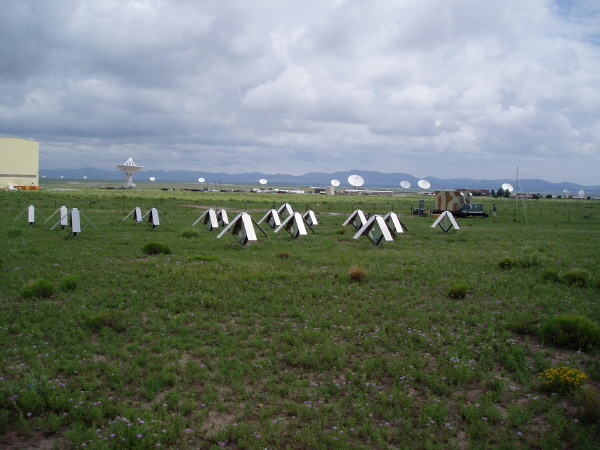
The photo at the left was taken in August 2006.
It shows the 16 dipoles of the
Long Wavelength Demonstrator Array (LWDA)
which is located on the site of
the Very Large Array
seen in the background. The LWDA serves as an
initial technical test bed for the LWA, the
project
inspired by Bill Erickson's historical legacy. Bill's
valuable scientific and technical guidance remain one
of the key assets of the project today.
| 